The Broken Promises of the Pan-American Highway
The Pan-American Highway has always sounded like an idea too elegant to fail. A single road linking the Americas. A continental artery running from Alaska to Patagonia. Distance dissolved by asphalt. Difference bridged by movement.
It was never just a road.
It was a promise.
The highway was meant to embody Pan-Americanism: the belief that the nations of the Western Hemisphere could be bound together through cooperation rather than domination, partnership rather than force. Infrastructure would do what politics could not. Connectivity would stand in for solidarity.
A century later, the road is still fragmented. And so is the promise it was built to carry.
Infrastructure Is Never Neutral
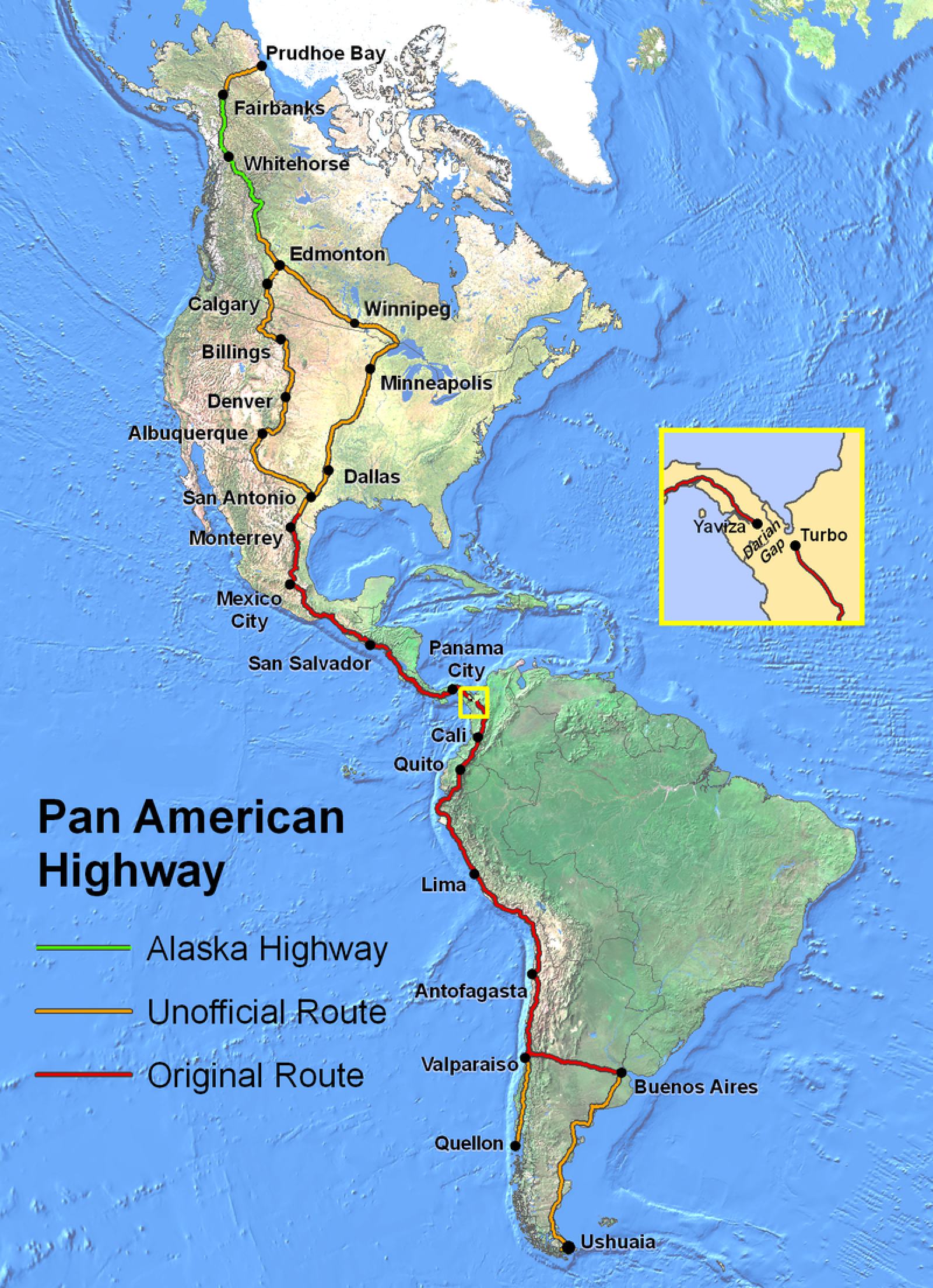
The Pan American highway. Well, at least the promise of it. Note the Darien Gap in the yellow box.
From the beginning, the Pan-American Highway was as much an ideological project as an engineering one. Roads do not simply connect places; they reorder them. They make territory legible to states, profitable to capital, and governable through speed and circulation.
The language surrounding the highway was lofty—unity, cooperation, hemispheric destiny—but its material priorities were clear. The road was designed to move goods efficiently across borders. It was far less concerned with how people lived along it.
In Mexico and Central America, the Pan-American Highway often functions as a freight corridor cutting directly through towns and cities. Long-haul trucks barrel past schools, markets, and bus stops. Pedestrians and cyclists negotiate danger daily. Mobility is optimized for throughput, not for life.
The road moves commerce smoothly.
It does not move people safely.
This imbalance is not a design flaw. It is the design.
The Broken Promise Made Visible: The Darién Gap
Nowhere is the failure of Pan-Americanism more visible than in the Darién Gap—the infamous break in the highway between Panama and Colombia.
The gap is often described as a technical problem, an environmental obstacle, an unfortunate interruption in an otherwise continuous system. But the Darién Gap is not an anomaly. It is a revelation.
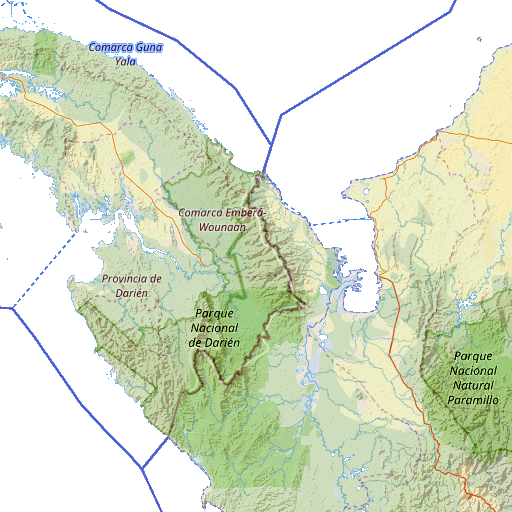
The Darien Gap. © OpenStreetMap contributors, cmglee, CC BY-SA 2.5 <https://creativecommons.org/licenses/by-sa/2.5>, via Wikimedia Commons
To complete the highway through the Darién would require confronting Indigenous sovereignty, ecological devastation, militarization, and migration. It would force planners and politicians to admit that “connection” is not benign—that roads carry violence as well as mobility.
The gap persists not because it cannot be filled, but because filling it would expose the contradictions Pan-Americanism has never resolved.
In that sense, the Pan-American Highway is not unfinished.
It is honest.
The Darién Gap tells the truth the rest of the road tries to obscure: hemispheric unity was always conditional, selective, and imposed from above.
Pan-Americanism Without Equality
Pan-Americanism promised cooperation, but it never resolved the problem of power. It spoke of unity while preserving hierarchy. It imagined a hemisphere bound together, but on terms largely set by the United States.
Goods were meant to move freely.
Sovereignty was not.
The highway reflects this perfectly. Capital flows north. Raw materials flow north. Influence flows south. When people attempt to move along the same corridor—especially migrants traveling north—the road becomes a site of surveillance, enforcement, and death.
The Pan-American Highway is continuous for supply chains.
It is discontinuous for human life.
This is not a historical footnote. It is the living legacy of a political vision that substituted infrastructure for justice.
The Return of Intervencionismo
That legacy matters now because Pan-Americanism has returned—not as a cooperative ideal, but as an openly coercive practice.
In January 2026, the United States carried out a military intervention in Venezuela that resulted in the forcible seizure of President Nicolás Maduro and his transport to the United States against his will. U.S. officials described the act as a lawful capture. Venezuelan officials and many governments in the region called it a kidnapping and a violation of sovereignty.
The terminology matters less than the fact itself:
a sitting head of state was taken from his country by foreign military force.
The intervention was accompanied by explicit discussion of Venezuela’s oil reserves, future licensing arrangements, and post-Maduro governance. Law enforcement language sat alongside resource calculus. Democracy talk sat alongside extraction plans.
For much of Latin America, the message was unmistakable.
Pan-Americanism still means that sovereignty is conditional.
From Roads to Raids
Seen in this light, the Pan-American Highway reads less like a failed dream and more like an early blueprint.
It imagined a hemisphere integrated for commerce but governed through hierarchy. Connected by roads, disciplined by power. Cooperation promised in rhetoric, intervention delivered in practice.
The Darién Gap marks where the fantasy breaks down geographically.
Venezuela marks where it breaks down politically.
Both expose the same truth: Pan-Americanism was never built to withstand equality. When consent falters, force fills the gap.
What the Highway Actually Teaches Us
The lesson of the Pan-American Highway is not that connection is impossible. It is that connection without equity is hollow.
Roads cannot substitute for political imagination. Infrastructure cannot redeem a history of intervention simply by running across it. Connectivity does not become solidarity just because it is paved.
If Pan-Americanism is to mean anything now, it would require starting where the highway failed:
with restraint rather than speed,
with sovereignty rather than management,
with care rather than throughput.
Until then, the Pan-American Highway will remain what it has always been:
a continental monument to a promise that was never fully kept—
and a reminder that unity imposed from above always leaves a gap.