


Building Bridges in U.S.–Mexico Higher Education
Advancing partnerships in research, innovation, and student exchange across borders
U.S.–Mexico Higher Education Partnerships
Strategy, relationship-building, and systems for durable collaboration
I support U.S. universities and international education organizations working to develop meaningful, goal-aligned partnerships with Mexican institutions and public agencies.
My work centers on partnership strategy, stakeholder engagement, and outreach systems, with particular attention to the political, institutional, and cultural contexts that shape collaboration across borders.
In August 2025, I represented the University of New Mexico at a high-level dialogue convened by Mexico’s Secretaría de Ciencia, Innovación y Humanidades (SECIHTI) in Mexico City. The meeting brought together international higher education leaders to explore how U.S. universities can contribute to Mexico’s national priorities.
Topics included public health challenges, sustainable agriculture, semiconductor development, electric vehicles, unmanned aircraft, earth observation systems, river remediation, and Mexico’s traditions of humanism.
This work reflects my broader focus: supporting international partnerships that move beyond formal agreements to produce durable, mission-aligned collaboration.
“I work on cross-border institutional partnerships at the intersection of higher education, public priorities, and relational infrastructure in the Americas.”
What I’m known for
Partnership strategy grounded in reality
I help institutions clarify what kind of collaboration is actually possible—given funding structures, political context, timelines, and capacity—so partnerships don’t collapse after the first meeting.Mexico-based outreach and relationship-building
Working from Mexico, I bring on-the-ground knowledge of the higher education landscape, public–private differences, and the relational dynamics that shape trust and follow-through.Relational infrastructure that lasts
I design the behind-the-scenes structures—engagement rhythms, documentation, and shared memory—that allow partnerships to endure beyond any single person or moment.
How I work
My work sits between strategy and relationship-building. I help institutions slow down just enough to understand context—political, institutional, and human—so collaboration doesn’t fail later.
Rather than starting with formal agreements, I focus on alignment first: goals, incentives, decision pathways, and capacity. From there, I help translate shared intent into structures that can actually be sustained.
In practice, this usually involves:
Clarifying what each institution wants—and what it can realistically offer
Identifying who holds authority, influence, and responsibility
Designing collaboration models that match scale and capacity
Establishing engagement rhythms and documentation practices
Producing clear, usable artifacts that support continuity over time
The result is not just a plan, but a way of working together that can survive turnover, shifting priorities, and institutional complexity.
Selected highlights
High-level dialogue on U.S.–Mexico higher education collaboration (Mexico City)
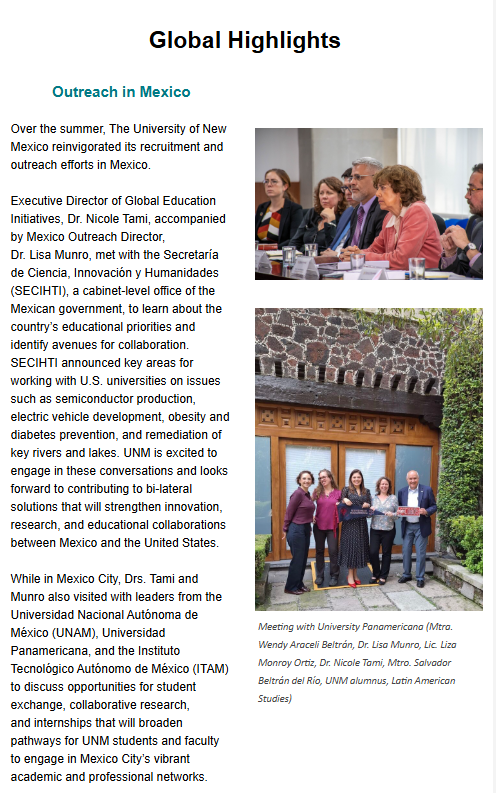
In August 2025, I represented the University of New Mexico at a dialogue convened by Mexico’s Secretaría de Ciencia, Innovación y Humanidades (SECIHTI), bringing together international higher education leaders to examine how U.S. universities can meaningfully contribute to Mexico’s national priorities.
The agenda spanned public health, sustainable agriculture, semiconductor production, electric vehicles, unmanned aircraft, earth observation systems, river remediation, and Mexico’s traditions of humanism—underscoring the scale of the challenges and the need for carefully designed international partnerships.
Focus of my work: strategic framing, institutional alignment, and relationship-building across sectors.

Speaking at SECIHTI on the responsibilities of international higher education partnerships in advancing public priorities.
Feature in UNM’s Global Education Office newsletter

Forms of collaboration
-
I work with institutions at the early and middle stages of cross-border collaboration—when goals are still forming, priorities need alignment, or feasibility is unclear.
This work focuses on clarifying what collaboration can realistically look like, given political context, funding structures, timelines, and institutional capacity. Rather than starting with formal agreements, I help partners establish alignment first.
This is often useful when:
Partnerships are aspirational but unfocused
Multiple offices or institutions are involved
Leadership needs clarity before committing resources
Typical outputs: strategy memos, partner shortlists, outreach framing, decision notes.
-
I design the behind-the-scenes structures that allow partnerships to endure—especially across staff turnover and shifting institutional priorities.
This includes identifying decision-makers and influencers, mapping how authority and responsibility move, and establishing engagement rhythms that don’t rely on any single person’s memory or inbox.
This is often useful when:
Follow-up keeps falling through the cracks
Authority is diffuse or unclear
Partnerships depend on sustained relationship-building
Typical outputs: stakeholder maps, engagement cadences, documentation structures, handoff guides.
-
I support the design and framing of cross-border programs, initiatives, and conversations—particularly when institutions need synthesis, alignment, or momentum.
This work often sits at the intersection of strategy and communication: translating complex contexts into shared understanding and next steps.
This is often useful when:
Developing programs tied to funding or policy priorities
Preparing leadership briefings or high-level discussions
Teams need structured facilitation to move forward
Typical outputs: concept notes, alignment memos, briefing materials, facilitation summaries, next-steps roadmaps.
I see collaboration as as relational infrastructure: alignment, documentation, and shared understanding before formal agreements.
Who this work is for
This work is a good fit if you are:
A university or mission-driven organization exploring U.S.–Mexico collaboration
Moving beyond exploratory conversations and seeking clarity and alignment
Working across multiple offices, institutions, or sectors
Interested in partnerships that are durable, reciprocal, and context-aware
Looking for collaboration models that can survive staff turnover and shifting priorities
When this work is not a fit
This work is likely not a fit if:
You are seeking a last-minute or symbolic partnership
You only need a generic MoU or template
There is no internal capacity to sustain the collaboration
The goal is branding rather than shared purpose
(These lines do important boundary-setting work. Keep them.)
Interested in working together?
If you’re exploring a potential collaboration and want to think through goals, feasibility, or next steps, I’m glad to have a conversation.
When you reach out, it’s helpful to include:
Your institutional goal or question
Any partners you’re considering (if applicable)
Your general timeline
Interested in learning more?
If you’re thinking about cross-border collaboration in higher education and want to talk through context, feasibility, or next steps, I’m glad to connect.