


Strategy & Governance

You need to understand how decisions are actually made.
I help businesses and organizations working across the U.S.–Mexico border figure out what's not working, why it isn't, and what to do next.
Understanding a complex institutional environment requires more than reading its policies. I examine the institutions, relationships, interests, and local conditions that shape how decisions are actually made—and what becomes possible in practice.

And yet, something isn’t working.
If you’ve ever tried to move a complex project, partnership, or initiative forward across institutions, sectors, or borders, you may have discovered that things don’t always work the way they do on paper.
You’ve done your homework and due diligence. The strategy makes sense. The right people seem to be involved. The approvals may even be in place.
All systems go, right?
Your project stalls like a set of rusty gears. Decisions that should be easy and simple become complicated and drawn out. Partners who seemed aligned begin pulling in different directions. Someone without an obvious role suddenly has enormous influence. The formal process says one thing, while what actually happens on the ground looks very different. An approach that worked perfectly well somewhere else runs into resistance here.
Meanwhile, the clock is running.
Every delay costs money. Your team is spending valuable time trying to solve a problem it can’t quite identify. Opportunities can disappear while everyone tries to figure out what—or who—is getting in the way. Everyone’s frustrated.
And the stakes may be higher than time and money.
Your credibility—and your organization’s reputation—may be on the line.
You need to know what is actually happening before you can decide what to do about it.
Formal rules tell us how organizations are supposed to operate. They don't always tell us how decisions are actually made.
That's where my work begins.

From Analysis to Action
Understanding the problem is only the beginning. I combine institutional research with practical strategy development to help organizations make informed decisions and determine what to do next.


Understand the Institutional Environment
Find out how things actually work.
investigate formal authority, institutional responsibilities, informal practices, stakeholder interests, and the relationships that shape decisions.
The objective is to understand not only what the rules say, but how institutions operate in practice.
Develop a Strategy
Identify what's possible—and what stands in the way.
I examine institutional vulnerabilities, competing interests, sources of resistance, and opportunities for cooperation.
From that analysis, I develop strategic options grounded in the realities of the institutional environment, rather than assumptions about how it ought to function.
Create an Actionable Roadmap
Turn institutional knowledge into practical decisions.
I identify which organizations need to be engaged, what decisions must be secured, how responsibilities should be structured, and what sequence of actions offers a realistic path forward.
The result is more than an explanation of the problem. It's a strategy for acting on what we've learned.
Analysis in Practice: What Parking Governance Reveals about Infrastructure and Risk
When a parking problem isn't really a parking problem.
Walk through Mérida, Mexico, and you'll encounter buckets, traffic cones, chairs, and other objects placed in public parking spaces. Businesses and residents use them to claim portions of the curb, effectively reserving public space for private use.
The practice is widespread, despite municipal regulations prohibiting unauthorized obstruction of public streets.
But the buckets are only the beginning of the story.
As demand for automobility has expanded, the institutions responsible for managing it haven't kept pace. Even as the city has pursued ambitious efforts to reclaim public space, the curb remains politically difficult to regulate. Informal claims persist, enforcement is uneven, and competing interests constrain what authorities can accomplish.
The visible problem is buckets. The underlying problem is contested governance.
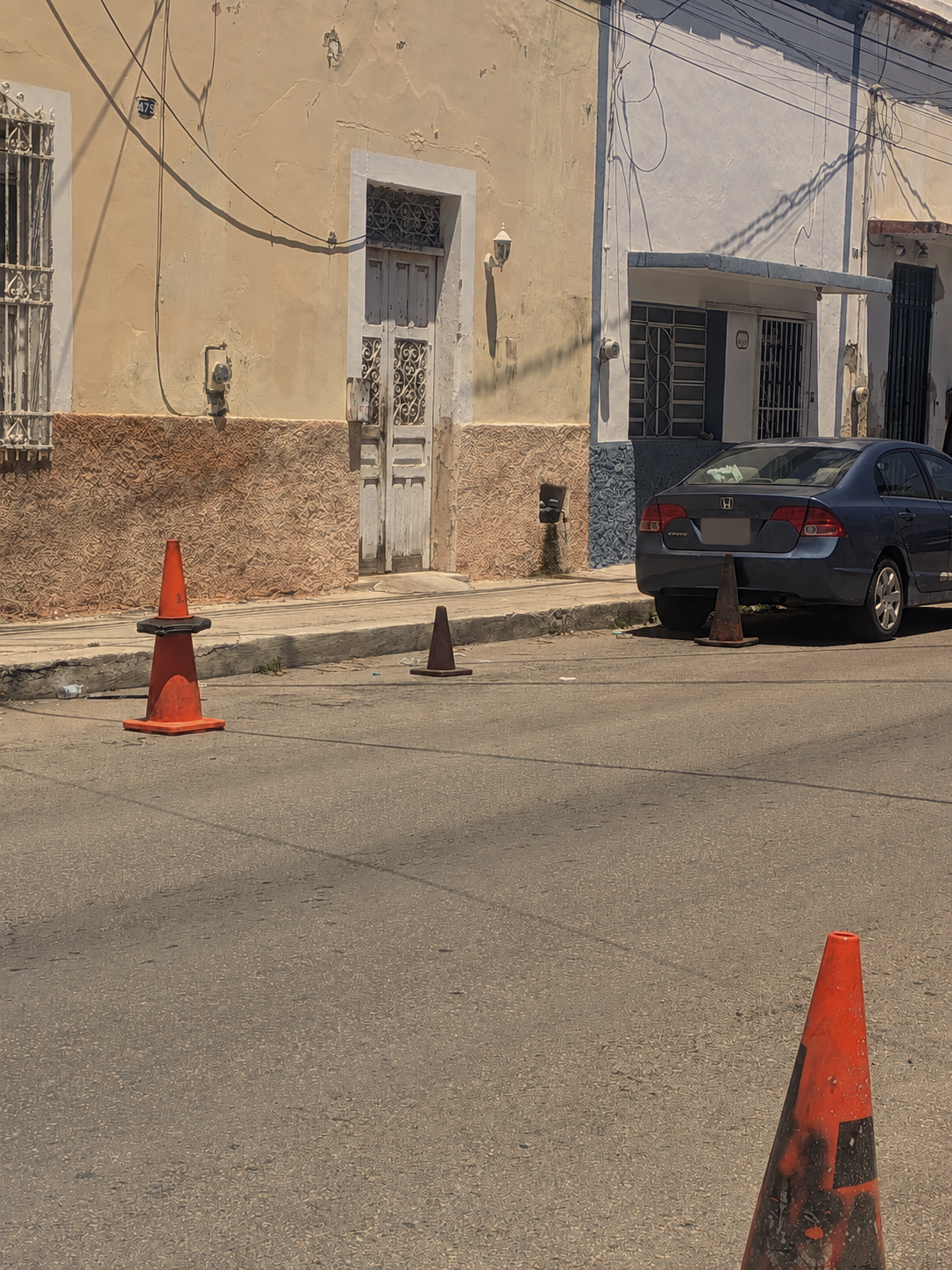
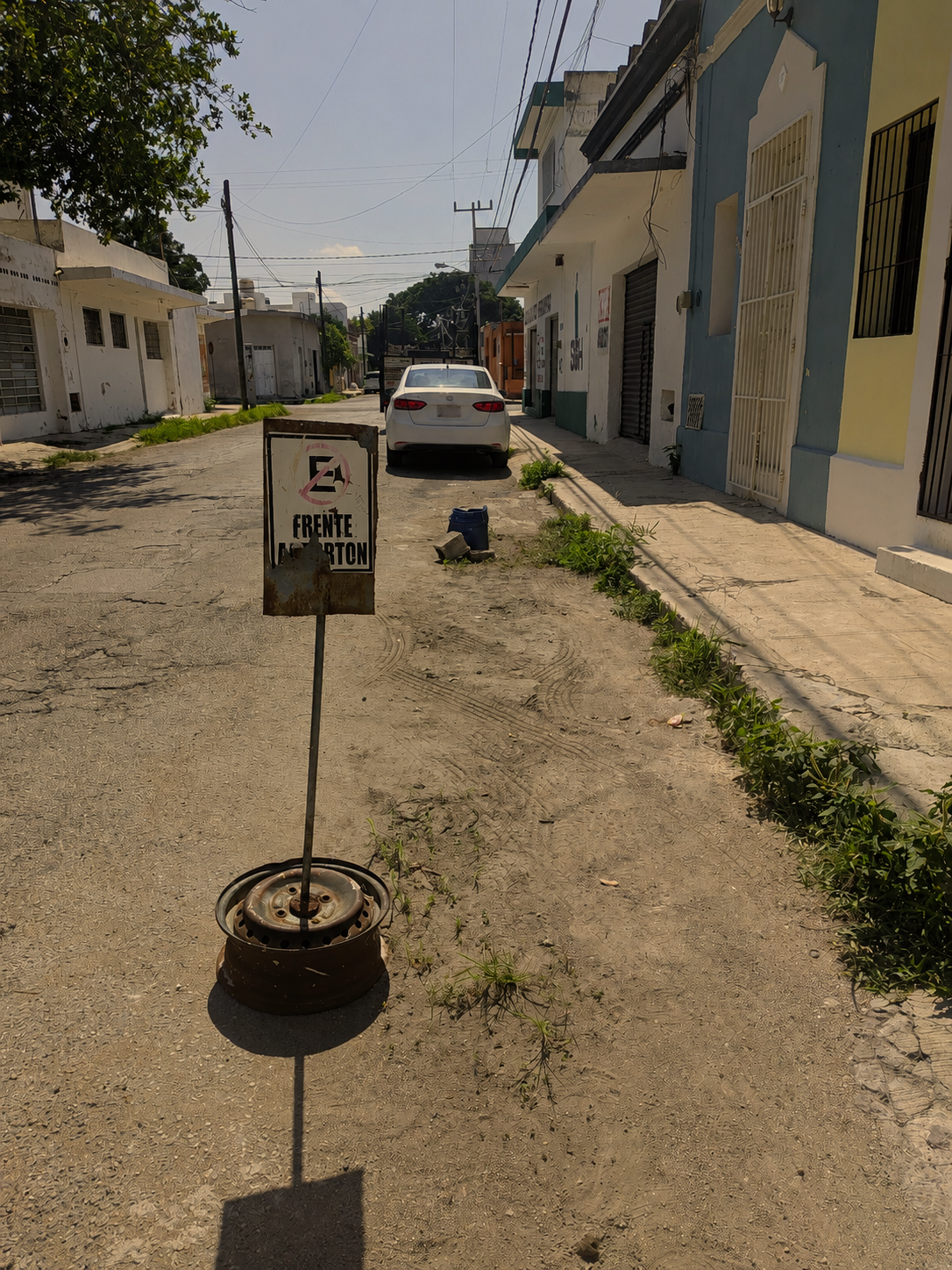
Buckets, cones, and other objects mark informal claims to public parking spaces in Mérida, where formal regulations and everyday practices coexist. These are photos I took during my fieldwork.

When I analyzed the street and how it worked, what I saw was not just a collection of household objects in a roadway. I saw a system shaped by scarcity, incentives, informal power, uneven enforcement, competing claims to public space, and deeply rooted expectations about who gets to use the street and for what purpose.
I traced the rules governing public streets, examined how those rules were enforced in practice, documented informal claims to curb space, and looked at the economic and political conditions that allow the practice to persist.
What does an informal system of parking space allocation have to do with infrastructure investment?
More than you might think.
A project can have technical feasibility, regulatory approval, and institutional support—and still encounter implementation obstacles because the organizations responsible lack the capacity or political room to act as expected.
Formal authority doesn't necessarily translate into effective governance. And institutional capacity isn't uniform: an agency may successfully implement one initiative while struggling with another that encounters different political interests.
For organizations managing complex infrastructure projects, understanding these differences can reveal risks that aren't apparent in technical plans, legal frameworks, or formal agreements.
The question isn't simply whether an institution has the authority to act. It's whether it can exercise that authority under the conditions your project will encounter.
What do you get when you work with me?
BETTER DECISIONS. SMARTER INVESTMENT. STRATEGIC ADVANTAGE.
You come to me because something is complicated, uncertain, or not working the way you expected. My job is to make the operating environment legible: to identify what is shaping the situation, explain why it matters, and help you understand what your realistic options are.
When our work is finished, you should have a clearer answer to three questions:
What is actually happening?
Not simply what the rules, organizational chart, strategy, or conventional wisdom say should be happening.
Why is it happening?
Which actors, interests, incentives, relationships, institutions, histories, and local conditions are producing the situation you see.
What can we do about it?
Where the risks and constraints lie, where you have room to maneuver, and which options are realistically available to you.
What Can We Work On Together?
When your cross-border project encounters institutional obstacles, understanding the problem is the first step toward solving it.
-
When a project isn’t moving as expected.
Identify the institutional obstacles, competing interests, unclear responsibilities, and informal practices affecting an existing cross-border initiative.
Typical deliverable: A diagnosis of what's happening, why it matters, and what needs to change.
-
When the next move isn't clear.
Evaluate strategic options, identify opportunities for cooperation, assess institutional risks, and develop a practical approach to resolving complex cross-border challenges.
Typical deliverable: Strategic recommendations, options and trade-offs, and a prioritized course of action.
-
When everyone agrees on the goal, but getting there is getting complicated.
Clarify institutional responsibilities, decision-making processes, stakeholder engagement, and the sequence of actions required to move an initiative forward.
Typical deliverable: An actionable roadmap with responsibilities, decision points, dependencies, and next steps.
Have a problem you can’t quite explain?
If something isn't working the way you expected—or you're preparing to make a consequential decision in an environment you don't fully understand—let's talk and figure out what’s happening.